Get in Touch
Tell us about your project and we'll get back to you within 2 business days.
Tedious AOI Programming
Start Inspecting
AI Programming in 5 minutes
The DaoAI P Series is an AI-powered automated optical inspection (AOI) system designed for PCBA manufacturing. It reduces new product introduction (NPI) programming from hours to 5 minutes using a single reference board — no CAD files, component libraries, or specialized engineers required. The system uses Feature Cognitive Inspection to understand physical component concepts rather than matching pixel patterns, achieving 99%+ detection accuracy with up to 80% fewer false calls than traditional AOI. Fully on-premise with under 12ms inference latency, the P Series integrates into any SMT line via standard SMEMA conveyors.
3 Hours to 5 Minutes
DaoAI SMT Visual AI only needs one reference board.
Rapid Modeling
Industry: Open CAD, build a component library, align one by one.
DaoAI: Scan one reference board — learned automatically.
AI Component Mapping
Industry: Rely on CAD or hand-draw ROIs; rotated parts never align.
DaoAI: AI locates components, pins, and polarity in seconds.
AI-Generated Thresholds
Industry: Tune RGB rules one by one, iterate endlessly.
DaoAI: AI derives thresholds from the reference board.
Inspection Ready
Industry: Needs a programmer; false-call fatigue makes inspection a formality.
DaoAI: Operators ramp up fast; AI keeps learning from feedback.
Voice of the Customer · Real AOI Pain Points
First-hand feedback from operators of mainstream systems
PCBA Process Engineer
"Initial programming on a new board takes hours, and tuning takes even more. The whole workflow feels clunky.
Agent learns from a single reference board — new-board changeover in 5 minutes.
SMT Line Engineer
"The system mishandles rotated parts — change one and others rotate too, never matching the real footprint.
Multi-dimensional feature recognition handles any orientation — rotation and flips matched accurately.
Production Process Lead
"Solder-joint and bridge inspection drags throughput so badly we just turn them off.
Full-board solder-joint and ball inspection without impacting line cadence.
EMS SMT Manager
"High-mix orders are a nightmare — no time to micro-tune every detail.
No reprogramming for high-mix orders — fast changeover preserved.
Quality Engineer
"Operators see false alerts so often they just hit pass without looking. Inspection becomes a formality.
AI iterates with operator feedback; false-call rate shrinks over time.
AOI Operator
"Review only happens at an offline station after the board exits — no in-line, in-time comparison.
Live in-machine review and on-the-fly tuning.
Agent learns from one reference board — 5-minute changeover.
Multi-dimensional features recognize any orientation — rotation, flips, accurately matched.
Agent learns from one reference board — no CAD, no library, no programming engineer.
Multi-Dimensional AI Detection · Overcoming Difficult Challenges
AI Component Alignment
Component surface contamination can degrade alignment accuracy, causing false positive. DaoAI uses AI algorithms for precise localization of contaminated components.
Same-Color Component Detection
When component body color matches PCB laminate, RGB color-based algorithms fail completely. DaoAI extracts multi-dimensional feature embeddings beyond RGB — reliably detecting components regardless of component color match.
DIP Solder Joint Classification (AI-Based)
DIP accept/reject criteria vary across customers, board types, and etcs. DaoAI trains a local AI classifier to your accept criteria — fast to deploy, high accuracy, no vendor dependency.
Black Inductor & Crystal Oscillator Mitigation
Chip inductors and crystal oscillators are notorious false-positive generators due to dense surface markings. DaoAI's multi-feature AI discriminator separates marking signatures from true defect signals — eliminating the root cause of false positives without rule-writing.
Detects All Defects:
Productivity Features
Traditional AOI VS. DaoAI AI AOI
| Evaluation Criteria | DaoAI AI AOI | Traditional AOI | Generic AI AOI |
|---|---|---|---|
| Training Methodology | Trained specifically on your golden boards | Manual rule-based programming | General pre-trained model, not customized |
| Programming Time | Operator completes in 5 minutes | 3-5 hours per board | Depends on AI engineer config |
| Data Security | Fully on-premise — data never leaves factory | N/A | Risk of IP exposure via cloud |
| Optimization | Continuously learns from operator feedback | Fixed algorithms, no auto-iteration | Improvements require vendor involvement |
| False Call Rate | Reduced by 80%; accuracy improves over time | High false call rate; escape defects present | Limited adaptability to specific processes |
Technical Features
Built on an industry-leading visual foundation model and trained on large-scale real-world SMT production data. Industrial-grade accuracy from day one.
Anomaly Scoring
AI-driven multi-dimensional feature extraction with anomaly scoring — not rule matching
Noise Immune
Model inference is feature-space, not pixel-space — immune to lighting drift and RGB noise
High Tolerance
High tolerance for optical variation, component lot-to-lot differences, and board warpage
Training Dataset: 1M+ Real-World Images
Factory-sourced image library spanning the full SMT component taxonomy. Continuously updated.
- OK: conforming component reference images
- NG: defect images across all failure modes
- 4x4 multi-orientation augmentation
- Active dataset expansion pipeline
AI Learns Directly from Real Samples
Employs Visual Foundation Model (VGG architecture) — convolutional neural network extracts features layer by layer for end-to-end deep learning.
- Conv1: 224×224×64
- Conv2: 112×112×128
- Conv3: 56×56×256
- Conv4: 28×28×512
- Conv5: 14×14×512
- fc6: 7×7×512
DaoAI AOI PCBA Visual AI
PCBA Visual AI Engine — Production-Grade Performance, Full-coverage defect taxonomy with <1ms per component inference speed.
- Missing / Wrong / Misorientated component
- Tombstoning / Physical damage / Polarity reversal
- Surface scratches / Foreign material contamination
Powered by DaoAI SMT Visual AI
The AI Brain Behind the Machine
Auto BOM Matching
Instantly sync scanned components to your BOM. No manual library creation.
Semantic False Call Filter
Intelligently distinguishes between 'Acceptable Variations' (oxidation, vendor font changes) and real defects.
Real-Time SPC Dashboard
Monitor defect trends, yield rates, and MES integration from a single interface.
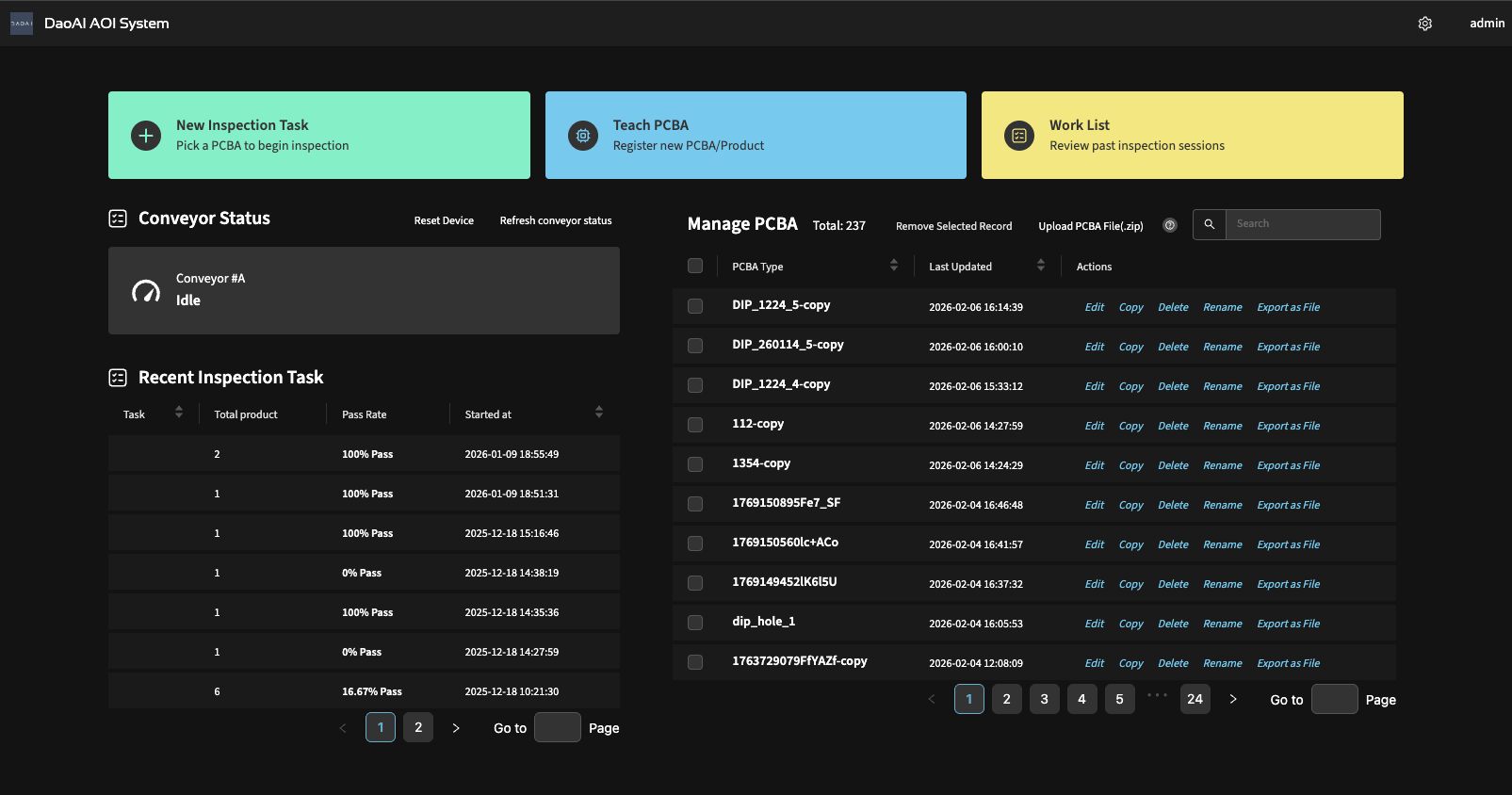
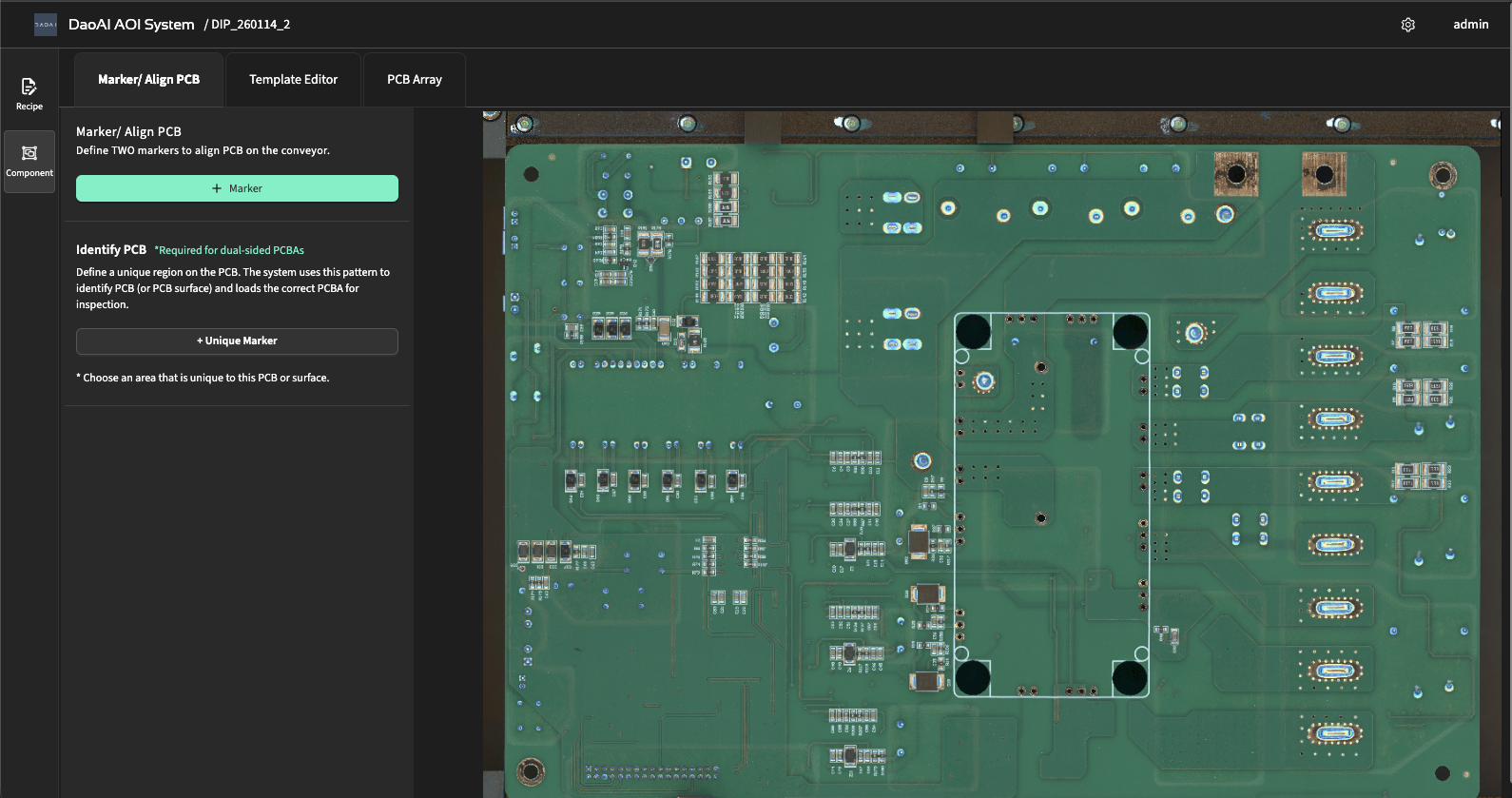
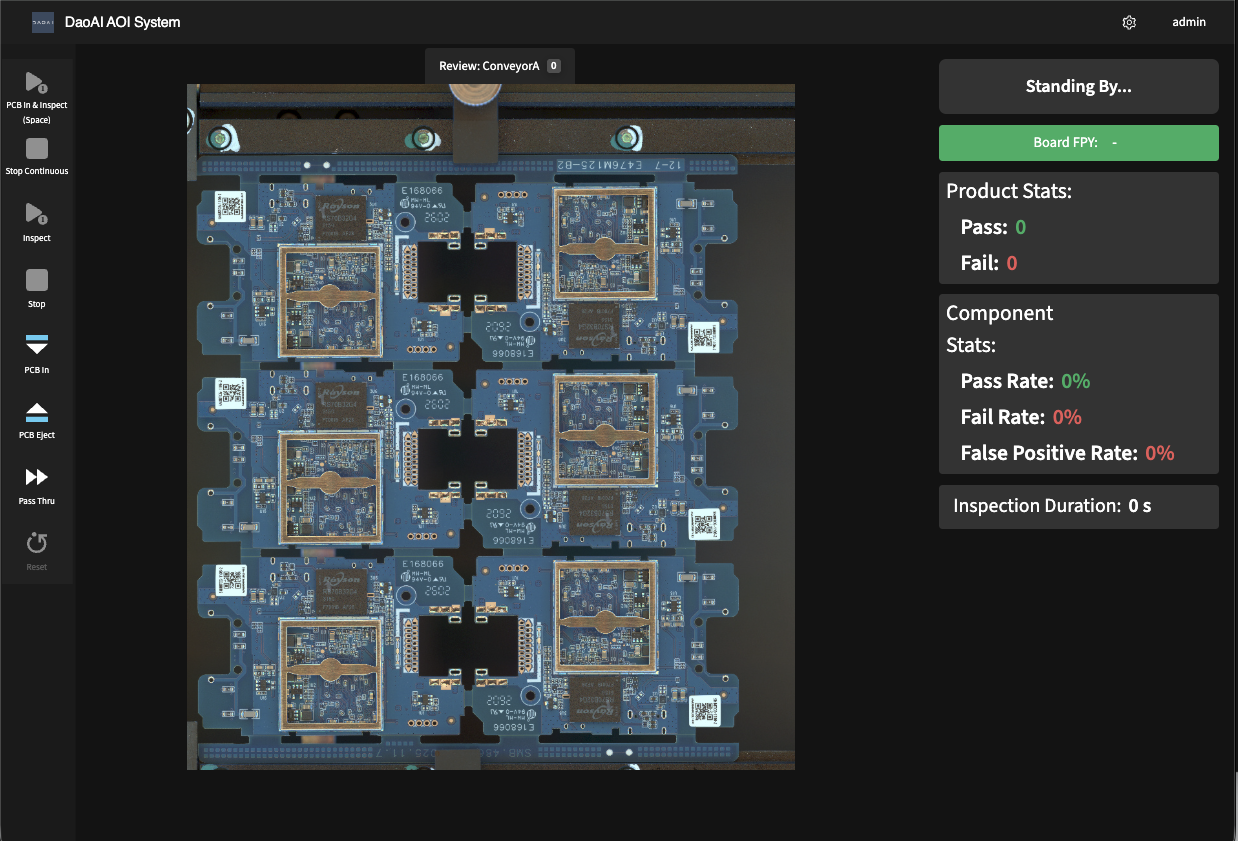
One Interface for Everything
- Program new boards in same UI
- Review flagged defects inline
- Export reports to MES
- Multi-language support (EN/CN)
Turn-key AOI solutions for PCBA
Purpose-built AOI machines powered by cognitive AI — from offline stations to high-speed inline systems.
THE HIGH-MIX DILEMMA
Unraveling the complexities of modern manufacturing and the elusive promise of the Smart Factory.
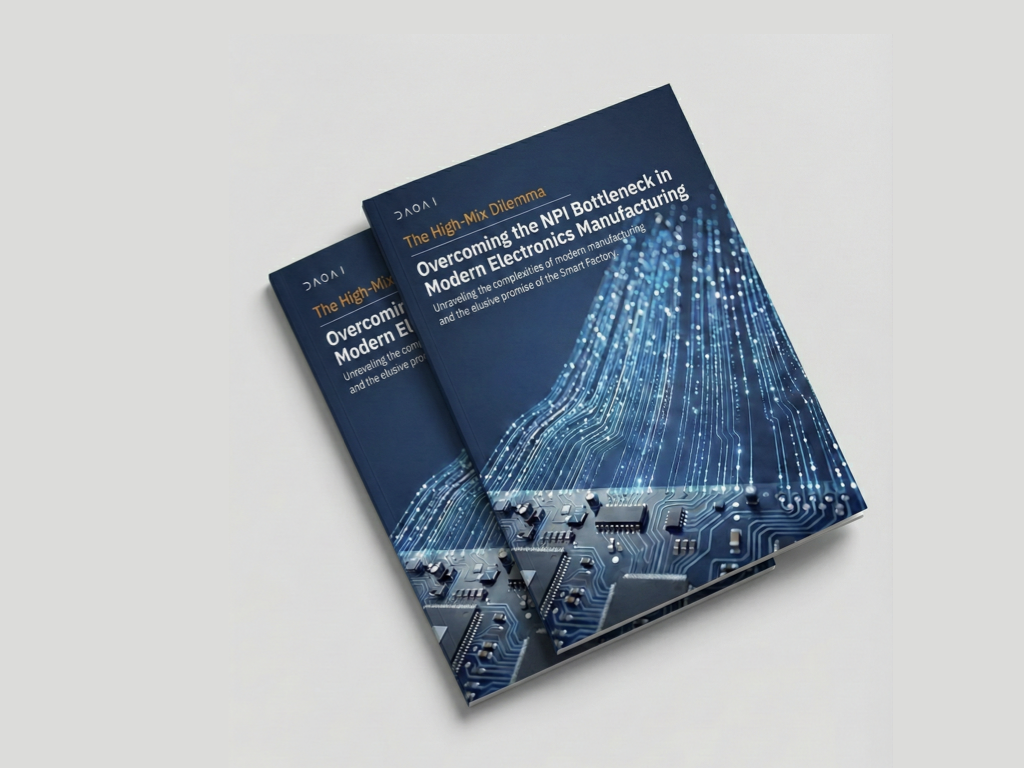
What is the 'NPI Paradox'?
How does DaoAI SMT Visual AI differ from Traditional AOI?
Do I need a 'Golden Board'?
Can it work with CAD files?
Offline 2D AI AOI Machine
DaoAI P1 & P2
DaoAI P1& P2 leverages advanced visual AI to automate PCBA inspection programming. By learning directly from golden sample, it auto-detects components, generates bounding boxes, and defines defect thresholds — accelerating setup from hours to 5 minutes.
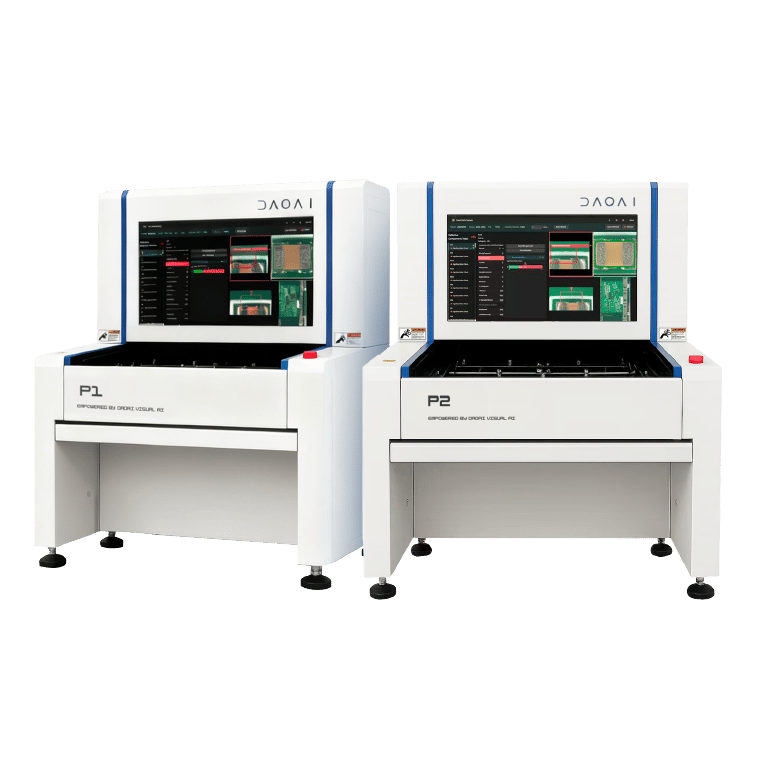
DaoAI P1/P2 Specifications
DaoAI P1
5MP0 Camera /month
DaoAI P2
12MP0 Camera /month
DaoAI P1
DaoAI P2
Optical System
Conveyor & PCB Size
Inspection Capability
Additional Functions
Inspection and Auto-Configuration Capabilities
|
Body |
Polarity | IC Leads |
Text
|
|
|---|---|---|---|---|
|
Capacitor |
|
|
|
|
|
Resistor |
|
|
|
|
|
Multilayer Chip
Inductor |
|
|
||
|
Aluminum Electrolytic
Capacitor |
|
|
|
|
|
Tantalum Capacitor |
|
|
|
|
|
Resistor Array |
|
|
|
|
|
Power Inductor |
|
|
||
|
LED |
|
|
|
|
|
SOT/SOD |
|
|
|
|
|
SOIC/SOP/TSOP/TSSOP/MSOP |
|
|
|
|
|
QFP |
|
|
|
|
|
QFN |
|
|
||
|
TO-263/TO-252 |
|
|